




- Published on: 2026-10-11 10:10:03
How to Build Trading Discipline: A Practical 2026 Guide

Trading discipline isn’t a test of willpower. It’s a repeatable process you can rely on when a fast-moving market tempts you to abandon your plan. If you’ve entered without a clear setup, moved an exit, or increased risk after a loss, learning how to build trading discipline starts with replacing split-second reactions with rules you set in advance.
It’s easy to judge a trade by its result. But a profitable outcome doesn’t automatically make the decision sound, just as a loss doesn’t prove your plan was wrong. Consistent execution gives you a clearer way to assess what happened and improve without turning one mistake into greater risk.
This practical 2026 guide shows you how to define entry, exit, and risk rules before trading, then build a preparation and review routine you can repeat. You’ll also learn how to pause after a mistake, manage emotional impulses, and assess decisions by your process, not just the outcome. The goal is a steadier approach you can apply trade by trade.
Key Takeaways
- Learn how to build trading discipline with specific rules that guide decisions and make it easier to review whether you followed them.
- Shape a trading plan around eligible markets, setup conditions, entries, exits, and personal risk limits.
- Use a repeatable preparation, decision-making, and post-session review routine to bring structure to each trading day.
- Respond to mistakes by pausing and reviewing what happened, rather than chasing losses or increasing exposure impulsively.
- Choose a trading environment that fits your approach, while keeping personal risk and accountability in view, including when copying another trader.
What Trading Discipline Means, and Why It Matters More Than One Trade
Trading discipline means following a prepared process, especially when fear, excitement, or frustration makes an unplanned action feel urgent. It isn’t about predicting every market move. It’s about deciding what conditions justify a trade, then acting within those rules rather than rewriting them under pressure.
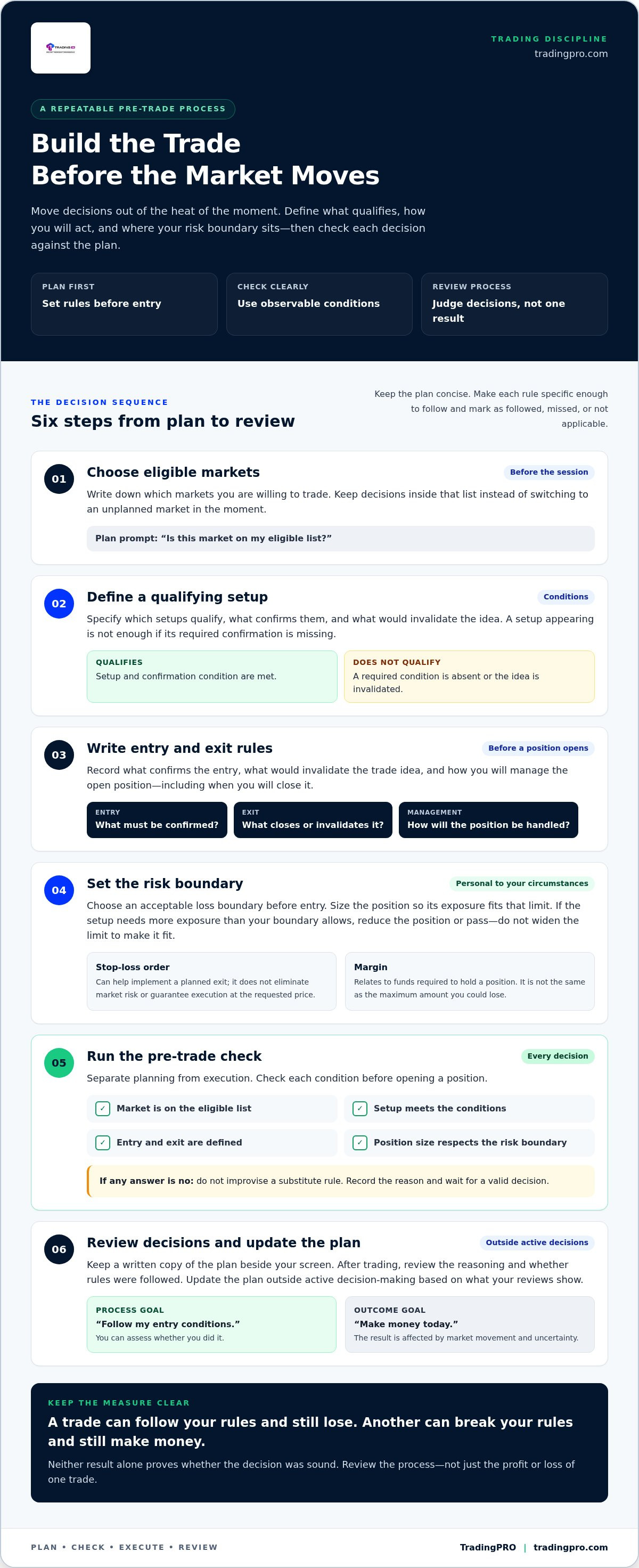
This is the difference between process goals and outcome goals. “Follow my entry conditions” is a process goal you can assess directly. “Make money today” is an outcome goal affected by market movement and uncertainty. A trade can follow your rules and still lose; another can break your rules and still make money. Neither result, on its own, proves whether the decision was sound.
Measure disciplined execution by the quality of the decision, not the size or direction of one trade’s result. Review the reasoning and rule-following behind each decision, not just whether the trade ended in profit. This gives you a more useful basis for learning and helps prevent a lucky result from reinforcing a risky habit.
Discipline Is a Process, Not a Personality Trait
You don’t need to be naturally unemotional to become more consistent. Written rules take pressure off memory and momentary motivation: you can check your conditions instead of inventing them in the heat of a decision. To learn how to build trading discipline, turn broad intentions into observable actions you can later mark as followed or missed.
For example, suppose your plan requires a defined setup and a confirmation signal before entry. The setup appears, but you’re uncertain because the market has moved quickly. If the conditions still qualify, following your written rule is disciplined execution. If they don’t, standing aside is disciplined too. Discipline doesn’t mean trading constantly or avoiding every loss. It means acting only when your process calls for action.
Why Emotions Can Disrupt a Trading Plan
Fear can prompt an early exit; excitement can turn a partial signal into an entry; frustration can push you to chase a loss. These reactions shift attention from the plan to the immediate urge to feel safer, catch up, or avoid missing out. That makes it harder to judge a setup on its actual conditions.
A common cycle starts with a losing trade. The trader feels pressure to recover, takes an unplanned position, then faces more stress if that trade also moves against them. The response can compound risk and cloud the next decision. Break the sequence: pause, return to your written rules, and assess whether you’re ready to act within them. If you’re building foundational knowledge alongside these habits, the Forex Trading for Beginners Guide can provide relevant context on the basics of currency trading.
Build a Trading Plan That Makes Disciplined Decisions Easier
A useful trading plan moves decisions out of the heat of the moment. Write down what you’re willing to trade, what conditions qualify as a setup, how you’ll enter and exit, and what risk boundaries apply. The aim isn’t to predict every move. It’s to make the next decision clear enough to check against your rules.
A useful trading plan records the market, setup, entry, exit, and acceptable risk before a position opens. Keep the plan concise, but make each rule observable. “Trade carefully” is hard to evaluate. “Enter only after the selected setup forms and the confirmation condition is met” gives you something specific to follow and review.
Turn Vague Intentions Into Observable Rules
Before the session, define which markets and setups are eligible, what confirms an entry, and what would invalidate the idea. Decide in advance how you’ll manage an open position, including when you’ll close it. Clear rules reduce the number of decisions you need to make while a price move is demanding your attention.
Set limits that reflect your circumstances and plan. There’s no universal risk amount that suits every trader. A stop-loss order can help implement a planned exit, but it doesn’t eliminate market risk or guarantee execution at the requested price. Treat it as one part of risk control, not a promise of a fixed outcome.
Set Risk Boundaries Before the Market Moves
Choose an acceptable loss boundary before entering, then size the position so its exposure fits within that limit. Position sizing connects the distance to your planned exit with the amount you’re prepared to risk. If the setup requires more exposure than your boundary allows, reduce the position or pass on the trade. Don’t widen your limit just to make the trade fit.
Consider margin separately. It relates to the funds required to hold a position, but it isn’t the same as the maximum amount you could lose. Understanding the distinction can help you assess exposure before entry. For more background, the article Risk Management: How to Calculate Margin in Seconds explores how margin fits into trading decisions.
Use a simple pre-trade check to separate planning from execution. Confirm that the market is on your eligible list, the setup meets your conditions, the entry and exit are defined, and the proposed size respects your risk boundary. If any answer is no, don’t improvise a substitute rule. Record the reason and wait for a valid decision. This makes how to build trading discipline practical: each rule can be marked as followed, missed, or not applicable.
Keep a written copy of your plan beside your trading screen and update it outside active decision-making, based on what your reviews show. A trading environment is only one part of that system; your rules remain yours to set and follow. As you put your approach into practice, you can register with TradingPRO and consider which account environment aligns with your process.
Create a Daily Trading Routine You Can Repeat
A repeatable routine gives each trading session a clear beginning, middle, and end. Prepare before the session, use the same decision checks when opportunities appear, then review your actions afterward. This sequence separates observation from execution, and reflection from the pressure of a live market.
Your routine doesn’t need to take a fixed amount of time or involve complex tools. It needs to fit your trading schedule and be consistent enough to use. A short written checklist helps prevent you from skipping preparation on busy days and makes your process easier to assess over time.
Prepare Before You Open a Position
Start by checking your plan and the market conditions relevant to your approach. Identify which setups you’ll consider and what would invalidate each one. Then check your readiness: notice whether distraction, fatigue, or emotional urgency could distort a decision. If your conditions aren’t present, no trade is a valid choice. Waiting is part of the routine, not a failure to act.
Use this adaptable checklist in order:
- Check your readiness. Note whether distraction, fatigue, or strong emotion could interfere with clear decisions.
- Review the market context. Focus on conditions relevant to your plan, rather than scanning for reasons to trade.
- Identify valid setups. Record what would qualify and what would invalidate each opportunity.
- Apply your rules in real time. Before acting, compare the opportunity with your written conditions.
- Close the session with a review. Record decisions and lessons before relying on memory to reconstruct them.
Review Decisions After the Trading Session
Journal the decision, not just the result. For each trade, record the setup, relevant context, whether you followed your rules, and what you felt before and during the decision. Add one specific lesson or question to revisit. A losing trade can still reflect a sound process; a profitable one can still expose a rule you ignored.
Write notes soon after the session and keep them factual. Recording what you saw and felt at the time helps limit hindsight bias, the tendency to reinterpret an earlier decision as obvious after the outcome is known. Separate observations from conclusions: “entered before confirmation appeared” is more useful than “I always make bad decisions.” Review patterns across multiple entries before changing your process.
This routine makes how to build trading discipline a daily practice rather than an abstract goal. Look for recurring friction, such as skipped checks or decisions made while distracted, then adjust one practical part of the routine at a time. If trading terminology or market basics are still unfamiliar, the Forex Trading for Beginners Guide can provide foundational context for your preparation and review.
Handle Impulsive Trades, Losses, and Broken Rules Without Escalating
Even a well-prepared trader can take a loss, feel frustrated, or make a decision that breaks their own rules. What matters is what happens next. Chasing a loss with a larger position or an unplanned trade can add exposure while emotions are already running high. It also makes it harder to tell whether the next decision comes from your strategy or an urge to recover quickly.
A reset process gives you a clear response before that pressure builds. Treat a rule breach as a signal to stop and review, not as a reason to punish yourself or trade harder. The aim is to contain the mistake, understand its trigger, and resume only when you can make a decision according to your plan.
Recognise the Triggers Behind Rule-Breaking
Common triggers include fear of missing out after a sharp move, frustration following a loss, or overconfidence after a winning trade. Note what happened just before the urge to act: perhaps you missed a setup, a trade moved against you, or you felt pressure to make the session “worth it.” Recording the trigger is information, not a verdict on your ability.
Set a pause condition in advance. For example, you might stop after an unplanned entry, a breach of your personal loss limit, or noticing that you’re trying to win money back immediately. Make the condition specific to your plan. A pause creates space to assess the decision instead of letting the next impulse dictate it.
Use a Reset Process Instead of Revenge Trading
After an unplanned trade or a broken rule, don’t jump straight into another position. Work through a reset sequence:
- Pause. Step away from new decisions while you feel reactive.
- Record the trigger. Write down what happened, what you felt, and what action followed.
- Review the rule. Compare the decision with your written plan and identify where you departed from it.
- Check your readiness. Resume only if you can assess a fresh opportunity on its own conditions, without trying to recover the previous result.
If you’re still focused on making back a loss, the reset isn’t complete. Ending the session can be the most disciplined choice. Don’t raise your exposure to erase a setback, and don’t treat a quick win afterward as proof that breaking your rules was justified.
Use your notes to identify a practical adjustment. If frustration after missed setups is a recurring trigger, define what counts as a valid entry and accept that some moves won’t qualify. If you repeatedly trade while emotionally charged, make that state an explicit pause condition. This is how to build trading discipline after a mistake: protect your risk boundary first, then turn the event into a specific lesson you can apply.
Once your reset routine is clear, you can create a TradingPRO account as one step toward putting your process into practice. An account environment doesn’t replace your rules; your decisions and risk boundaries remain central.
Put Trading Discipline Into Practice With the Right Trading Environment
Your trading environment can help you carry out a routine, but it can’t make disciplined decisions on your behalf. Your rules still need to come from you: what you’ll trade, how you’ll assess opportunities, and what personal risk limits you’ll follow. Choose an environment that fits your approach, then use your written process consistently within it.
Self-directed trading and copy trading place different demands on your attention, but neither removes personal accountability. When you make each decision, check it against your plan. When you copy another trader, understand the activity you’re following and decide whether it fits your own objectives and risk boundaries.
Choose an Account Context That Matches Your Learning Stage
TradingPRO offers Rookie, Micro, Pro, and Scalp account tiers. The Rookie Account is one account option to consider as you build your approach. An account choice alone won’t establish a routine or determine how you manage risk. Consider your learning stage and the process you intend to follow, then keep your rules central to each decision.
If you’re still building foundational knowledge, the Forex Trading for Beginners Guide can help you strengthen your understanding of core terminology and concepts. Clear foundations make it easier to interpret what you’re doing and evaluate whether an approach aligns with your plan. That context supports discipline, but it doesn’t replace setting personal limits or reviewing your choices.
Treat Social and Copy Trading as Tools, Not Discipline Shortcuts
Social Trading and Copy Trading can offer a different way to participate, but copying another trader doesn’t transfer their objectives or risk tolerance to you. Before following another market participant, define what you want from the activity, what exposure you’re comfortable with, and what would prompt you to stop or reassess. Don’t treat another trader’s decision as an automatic fit for your circumstances.
Make accountability explicit. In self-directed trading, review how your own analysis led to an entry or exit. In copy trading, assess why you chose to follow a participant and whether continuing still fits your plan. In either case, record your reasoning and take responsibility for your personal risk decisions. These checks make the environment part of your process, not a substitute for it.
A consistent routine is the practical core of how to build trading discipline. Choose an account context that suits your learning stage, define your boundaries, and bring your written rules to every session. Register with TradingPRO to take the next step in putting that process into practice.
Make Your Next Session a Deliberate One
Discipline grows through small, repeatable choices. Your next session doesn’t need to prove anything. Treat it as a chance to practise your process, notice where pressure affects your decisions, and make one thoughtful adjustment afterward. That feedback loop is a practical way to approach how to build trading discipline without demanding perfection from yourself.
Set your rules before you begin, then use them as your reference point when the market gets fast or your confidence shifts. Progress comes from returning to the plan, learning from each decision, and protecting your ability to make the next one calmly. The goal isn’t to control every outcome. It’s to strengthen how you respond.
Ready to put your approach into practice? Register with TradingPRO, bring your written rules to each session, and keep building consistency one decision at a time.
Frequently Asked Questions
How long does it take to build trading discipline?
There’s no fixed timeline; progress depends on how consistently you practise and review your decisions. Focus less on reaching a deadline and more on measurable changes, such as fewer impulsive entries or clearer records of why you acted. To assess how to build trading discipline, review your habits across different sessions, including quiet markets and periods of heightened emotion. One strong day isn’t the same as a reliable routine.
Can you be a disciplined trader and still lose money?
Yes. A disciplined decision can still lose because a well-considered trade doesn’t control what the market does next. Separate the quality of your decision from the result, then assess whether the idea and its risk were consistent with your approach. If losing trades repeatedly come from the same type of setup, examine that pattern across a broader sample. A single loss alone can’t establish that a strategy or decision was poor.
What should I do after breaking my trading rules?
First, avoid making another trade just to compensate for the breach. Note the rule you broke and the circumstances around it, such as entering after a sudden price move. Then review the event when you’re calm and decide whether the rule was unclear, overlooked, or deliberately ignored. Don’t rewrite your plan to excuse one trade. If you can’t assess a new opportunity objectively, end the session and return later.
Does a trading journal improve discipline?
A journal can help you spot repeated habits, but writing entries alone won’t change behaviour. Add a simple tag to each trade, such as “planned,” “early entry,” or “exit changed,” then compare those tags with your notes about the market context. Review the patterns regularly. This can show whether a particular setup or emotional state tends to coincide with missed rules, without judging decisions only by profit or loss.
How can I stop emotional trading after a loss?
Don’t make recovering the lost amount your next objective. That target can pressure you to take trades your usual criteria wouldn’t allow. Instead, decide in advance what signals that you’re too reactive to continue, such as repeatedly checking your account balance or feeling compelled to enter immediately. Step away until you can evaluate a fresh opportunity on its own merits. If that point doesn’t come during the session, stop trading for the day.
Does copy trading remove the need for trading discipline?
No. Copy trading changes who makes the initial trade decision, but you still need to judge whether following that activity suits your objectives and personal risk limits. A copied position may create exposure that feels uncomfortable for your circumstances, even if another trader chose it. Decide what would make you pause or stop following, and review those choices regularly. Treat copying as a participation method, not a substitute for understanding your own decisions.
How do I measure trading discipline if I am not measuring profit?
Track actions you can verify. For each opportunity, record whether it met your entry criteria, whether you respected your planned exit, and whether the position stayed within your personal limits. Include valid setups you passed on, since those can reveal whether hesitation or distraction affected your choices. Review records by setup type or session context to find patterns. These measures assess execution; they don’t predict profits or guarantee future results.


