




- Published on: 2026-10-12 05:02:55
How to Verify ASIC-Regulated Brokers: 2026 Guide

A licence number on a broker’s website can look convincing and still leave the key question unanswered: does it belong to the exact company and trading service you’re considering? Knowing how to verify broker regulation means checking the official record, not relying on a logo or a number that could be copied or misrepresented.
That extra scrutiny matters because brokerage groups can operate through different regional legal entities, and company registration alone doesn’t prove that a specific service is authorised. Before sharing your details or depositing funds, match the company named in the account terms with the regulator’s official records.
This guide explains how to check an ASIC-related claim using ASIC’s registers, then compare the legal entity, licence status, permissions and website domain. You’ll learn what an Australian Financial Services Licence (AFSL) does and doesn’t tell you, and how to spot gaps between a broker’s marketing and its official record. ASIC authorisation is not global approval or a guarantee of safety, so use the evidence to make an informed decision about whether to proceed with registration.
Key Takeaways
- Use ASIC’s official registers to check the broker’s current licence record, not just a website badge or screenshot.
- For how to verify broker regulation, match the licence holder’s exact legal name with the entity named in the account terms.
- Check that the licence permissions align with the specific financial service being offered.
- Compare the official record’s contact details and website with the domain you’re using to spot lookalike sites.
- Complete your entity, licence, permissions, domain and account-term checks before deciding whether to register. Regulation alone isn’t a recommendation to trade.
What ASIC regulation means when you are checking a trading platform
A broker’s claim of “ASIC regulation” is useful only when it identifies the right company and the financial services that company is allowed to provide. The Australian Securities and Investments Commission (ASIC) is Australia’s corporate, markets and financial services regulator. For traders, the practical question is whether the specific legal entity behind the account has the relevant authorisation, not simply whether the brand mentions ASIC.
This distinction is central to how to verify broker regulation. A company can be registered as a business without holding an Australian Financial Services (AFS) licence. Company registration and financial services authorisation serve different purposes, so one record cannot stand in for the other.
What does ASIC-regulated mean for a broker?
An AFS licence relates to providing financial services in Australia. Its holder may provide the services covered by its authorisations, subject to applicable conditions. The word “regulated” on a website doesn’t show which company holds the licence or what activities its permissions cover. Read the licence record and compare it with the specific service being offered.
Keep these distinctions clear:
- Company registration: identifies a company in a corporate register. By itself, it doesn’t establish permission to provide financial services.
- AFS licence: relates to financial services authorisation and lists the relevant licence details and permissions.
- Marketing claim: describes what a broker says about its status. Treat it as a lead to verify, not as proof.
A licence is not a blanket approval for every product or service associated with a brand. For example, permission relating to one type of financial service shouldn’t be assumed to cover a different one. Match the stated service to the licence holder’s recorded permissions, then assess trading risks separately. Regulatory status cannot guarantee a profit, prevent losses or make a trading platform risk-free.
Why the broker’s legal entity matters
A single brokerage brand can operate through separate companies in different regions. Those entities can have different regulators, licensing status and customer terms. TradingPRO identifies regional entities including Trading Pro Ltd in Mauritius and Trading Pro (PTY) LTD in South Africa. Naming these companies does not establish that either is ASIC-regulated.
Find the exact company named in the account application or client agreement. Then compare that legal name with the entity shown in the regulator’s records. Don’t rely on a group brand, an affiliate’s licence or a licence number displayed elsewhere on the site. If the names don’t match, pause and establish which entity would actually provide the service and hold the account.
Before moving forward, anchor your review to four specifics:
- The full legal name in the account terms.
- The regulator and licence associated with that entity.
- The permissions relevant to the trading service being offered.
- The website and contact details connected to the official record.
This entity-first approach makes an ASIC claim testable. It also keeps Australian authorisation in its proper scope: it concerns the named licensee and its permitted services, not every company or operation using the same brand worldwide.
How to verify broker regulation through ASIC’s official registers
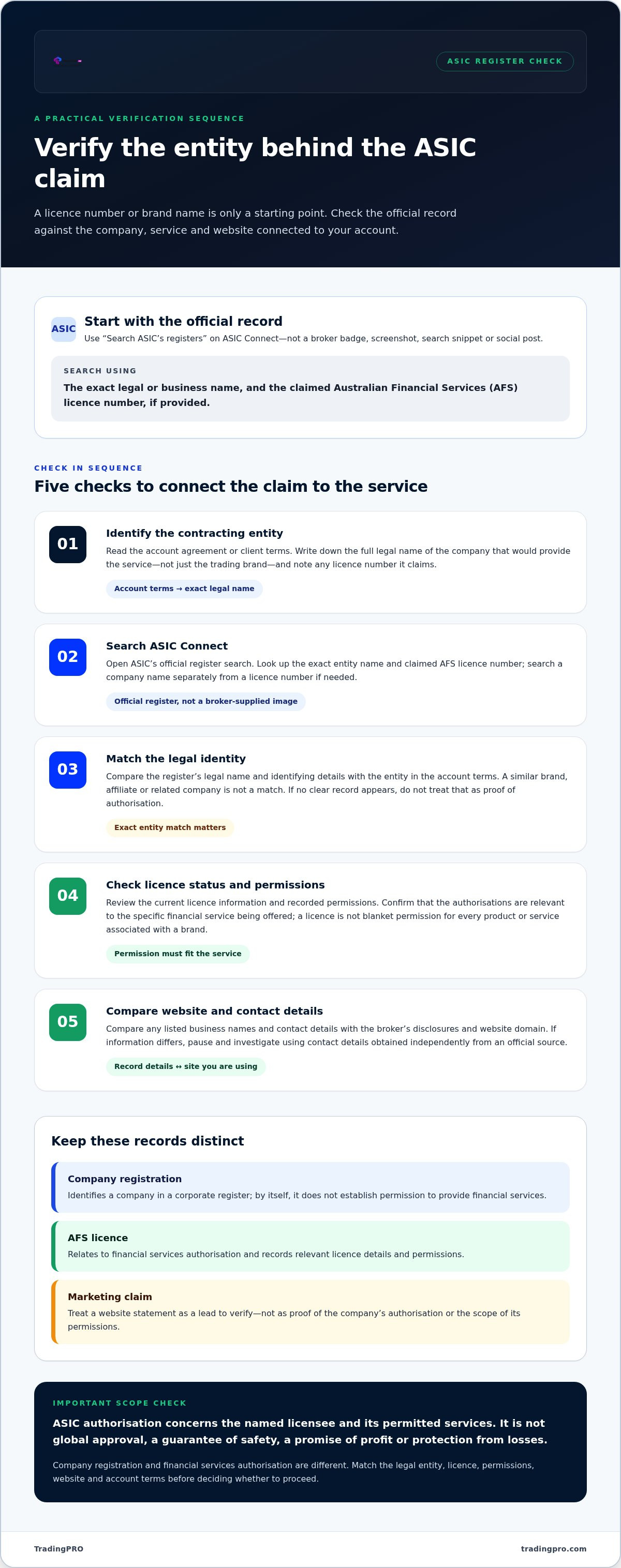
Move from the broker’s claim to an independent record. ASIC’s official “Search ASIC’s registers” function on ASIC Connect lets you search by a business name, company name or Australian Financial Services (AFS) licence number. Use the register itself, not a search-engine snippet, social post or image supplied by the broker. This is the practical core of how to verify broker regulation: identify the contracting firm, locate its official entry and check whether the recorded details fit the service and website in front of you.
Find the exact legal entity and licence record
Start with the account agreement and relevant disclosures. Note the complete legal name and any AFS licence number, then search ASIC Connect. Try both the exact entity name and the claimed number. Compare the spelling and identifying details in the result. A similar brand name or a related company is not a match. If the initial search returns no clear record, don’t treat that as proof of authorisation.
Match permissions, status, and online contact details
Open the register entry and examine its current status, licence information and permissions. Check that the recorded authorisations are relevant to the financial service the broker offers. Compare any listed business names and contact details with the broker’s disclosures and official website. If information differs, pause before submitting personal or payment details, and investigate using contact information obtained independently from an official source.
Follow this sequence and keep the details together as you check:
- Identify: Write down the legal entity named in the client agreement, not just the trading brand. Record the licence number the broker claims, if one is provided.
- Search: Go to ASIC’s official website, open “Search ASIC’s registers” in ASIC Connect, and look up the exact legal name and claimed licence number. If needed, search a company name separately from an AFS licence number.
- Match: Compare the result’s legal name and identifying information with the contracting entity. Don’t accept a near-match, parent company or affiliate as a substitute for the company named in your terms.
- Check permissions: Review the licence status and recorded authorisations. Consider whether they relate to the specific financial service being offered, rather than assuming a licence covers every activity or product.
- Verify contact details: Compare available register details with the broker’s disclosures and website. Check the domain carefully for misspellings or extra words, and don’t rely on a link supplied in an unsolicited message.
Reliable verification matches the firm, its permissions and the website you’re using. A genuine register entry alone doesn’t prove that a particular website belongs to that licensee. Treat conflicting names, unclear permissions or mismatched contact details as reasons to stop and investigate through official channels.
Complete these checks before considering account registration. Once you’ve made your own regulatory and entity assessment, you can review the account registration details alongside the applicable terms and decide whether to proceed.
ASIC-regulated claims: compare the licence, entity, and service
A licence record is only one part of the verification picture. Compare it with the contracting company, the service being offered and the website where you’re opening an account. This check can expose a common gap: a broker group may mention a genuine licence, while the customer’s agreement names a different company.
Use this table as a comparison framework. Fill in each field using the account terms, broker disclosures and the relevant regulator’s current records. Don’t treat blank or conflicting fields as proof of authorisation.
| Check | What to compare | What the comparison tells you |
|---|---|---|
| Brand | Name used in advertising and on the platform | Identifies the trading name, but not necessarily the contracting company |
| Legal entity | Company named in the account agreement | Shows which firm is presented as providing the service |
| Regulator | Authority named in the firm’s disclosure and official record | Identifies the jurisdiction whose register you should check |
| Licence | Licence type, number and current record | Connects the authorisation to a named licensee |
| Permissions | Services recorded for that licensee | Helps assess whether the authorisation relates to the service offered |
| Website | Domain and contact details in use | Helps determine whether the site appears connected to the recorded firm |
What an ASIC licence check can and cannot establish
An ASIC record concerns the named licensee and the information and permissions shown for that entity. It doesn’t automatically establish that a separate company in the same corporate group holds the same authorisation. Nor does a listing decide whether a service is suitable for you, confirm that you’re eligible to use it or guarantee a particular level of investor protection. For any jurisdiction-specific conclusion, rely on that regulator’s current official records and guidance.
A group’s regulation does not establish each affiliate’s status. A valid ASIC record for one company cannot, on its own, verify the regulatory position of a different legal entity. Likewise, oversight by another jurisdiction’s regulator is distinct from ASIC authorisation. Check the relevant authority and licence for the company named in your own terms.
How to assess an international broker group
For an international brokerage, compare the contracting entity against the exact company on the regulator’s register. TradingPRO identifies Trading Pro Ltd in Mauritius and Trading Pro (PTY) LTD in South Africa as regional entities. Those names identify companies, not an ASIC status. Check the relevant authority’s current records for the entity and service applicable to your account.
Apply the same standard to any group: don’t transfer a licence from a parent company, affiliate or another regional operation to the firm named in your agreement. As you work through how to verify broker regulation, look for a consistent chain from entity to regulator, licence, permissions and domain. If one link points to a different company or jurisdiction, treat the claim as unresolved until you can confirm the relationship through official records.
Red flags to spot while verifying a broker’s regulation
A genuine licence record can be misused. A website may copy a real licence number, borrow a similar company name or imitate the domain of a regulated business. The details can look polished and still point to the wrong firm. Treat regulator claims as unverified until the entity, licence information, permissions and online presence align with official records.
Recognise clone-firm and impersonation warning signs
Compare the broker’s domain, email address, phone number and company name with details in the regulator’s records. Look for small differences, such as an added word in a web address, a swapped letter in a company name or a free email account where the official record lists another contact method. A badge, screenshot or search-result excerpt isn’t an official record. It can be copied, outdated or detached from its original context.
Slow down if you see any of these signals:
- The licence number belongs to a different legal entity, even if the brand names look alike.
- The broker’s site uses a domain that differs subtly from the one associated with the firm in official records.
- Contact details in the platform disclosures don’t match the regulator’s published details.
- A message pressures you to act quickly or sends you to a link or phone number that appears nowhere in official records.
Verify contact details using independently located official records. Don’t call a number or follow a link found only in a suspicious message or on the site you’re trying to authenticate. Locate the regulator’s official website yourself, then use its published resources to confirm the firm’s details. This independent route matters because a convincing copy of a legitimate licence page can still direct you to an impersonator.
What to do when a record does not match
If the licence, entity, permissions or contact information conflicts with the broker’s disclosures, pause. Don’t register, deposit or share sensitive information while the discrepancy remains unresolved. A mismatch may have an innocent explanation, but it isn’t proof of one. Recheck the information through the relevant regulator’s official resources, and look for confirmation tied to the exact company and service you’re considering.
Keep a simple, dated record of your review. Save or note:
- The full legal entity name shown in the account terms.
- The licence number, regulator and status displayed in official records.
- The permissions relevant to the proposed service.
- The website domain and contact details you compared.
These notes help you spot whether details change between a regulator search and a later account application. They also give you a clear basis for deciding whether to proceed, wait or walk away. If the firm’s explanation points to another company or jurisdiction, verify that separate claim independently rather than assuming it resolves an ASIC mismatch. That discipline is central to how to verify broker regulation without relying on logos or confident marketing language.
After completing your checks and reviewing the applicable account terms, you can begin account registration if you decide to proceed.
Complete your broker checks before choosing an account
Finish the verification before you compare account options or enter personal information. A clear result from a regulator is useful, but it isn’t a recommendation to trade, a guarantee of safety or evidence that a product suits your goals. Use how to verify broker regulation as one part of a broader decision that includes the contracting entity, your jurisdiction, the service offered and the risks you’re prepared to take.
Use a final pre-registration verification checklist
Before deciding whether to open an account, review each point against the broker’s current disclosures and official records. If a name, permission or domain doesn’t line up, stop and resolve the difference before proceeding.
- Entity: Identify the exact legal company that will hold the client relationship and appear in your agreement.
- Regulator: Confirm which authority oversees that specific entity, rather than relying on a group-wide claim.
- Licence: Check the current official record and confirm it belongs to the same company named in the account terms.
- Permissions: Compare the authorisations with the financial service you intend to use.
- Domain: Check that the website and contact details match information connected to the official record.
- Terms: Read the applicable client agreement and risk disclosures. Make sure you understand which company provides the service and the risks involved.
Keep the checks tied together. A licence for one company, a matching brand name or a polished platform doesn’t settle whether the entity in your agreement has the relevant authorisation. If you’re still building market knowledge, review foundational trading concepts with a beginner trading guide before making an account decision. Regulatory status and market understanding answer different questions.
Explore account options only after checking the details
Once you’ve assessed entity and jurisdiction fit, compare account types on their own terms. TradingPRO offers Rookie, Micro, Pro and Scalp account tiers. The tier name alone doesn’t explain whether an account aligns with your objectives, so read its applicable details and terms before choosing. If you want to review the Rookie Account, consider it only after completing your own regulatory checks.
Take the next step only if the verified entity, relevant permissions, website and account terms make sense for your situation. If any key detail remains unclear or inconsistent, pause rather than letting a registration flow rush your decision. If you decide to proceed, you can begin account registration. This is an optional step, not an endorsement of a particular account or a claim of ASIC approval.
Make your next move with clarity
Strong decisions start with evidence, then move at your pace. Apply how to verify broker regulation whenever you assess a platform, and treat unresolved differences as a signal to pause rather than a detail to overlook. Regulatory status is one factor in your decision, not a reason by itself to trade.
As you consider TradingPRO’s Rookie, Micro, Pro and Scalp account tiers, focus on the account terms and the regional entity that would apply to you. Make sure they fit your jurisdiction and your own trading goals. Take time to decide. Registration is an option, not an obligation.
If you’ve completed your checks and are ready to take the next step, explore account registration. Move forward with care, confidence and a clear understanding of your choices.
Frequently Asked Questions
How do I check whether a broker is regulated by ASIC?
Search ASIC Connect’s official registers using the broker’s claimed AFS licence number or the full legal name shown in its client agreement. For how to verify broker regulation, compare the result with the company, service and website you intend to use, rather than relying on a brand-name match. If a result is unclear, try the other search detail and review the register entry itself before making a decision.
Can I trust a broker if its ASIC licence number appears on its website?
No. A displayed number is a claim to check, not proof that the website belongs to the licensee or that the licence covers the advertised service. Search the number independently in ASIC’s register, then compare the recorded company name with the entity in the client agreement. For example, a real number paired with a different company name needs investigation before you share personal details or funds.
What does an Australian Financial Services licence allow a broker to do?
An Australian Financial Services licence authorises its holder to provide the financial services covered by its recorded permissions and applicable conditions. It doesn’t mean the company can provide every kind of financial service. Read the licence information alongside the service being offered. If the broker advertises multiple activities, don’t assume one permission covers them all. Assess each claim against current official records.
Is an ASIC-regulated broker automatically safe to trade with?
No. Regulatory status doesn’t remove market risk, guarantee profits or establish that a trading product suits your circumstances. Treat verification as one part of your decision, alongside understanding the product, costs and risks described in the broker’s terms. For instance, a valid licence record won’t tell you whether you can tolerate potential losses. Make that assessment separately, and don’t trade solely because a broker cites a regulator.
How can I tell whether an ASIC licence belongs to the broker I am considering?
Check the account agreement for the full contracting company name, then compare it with the licensee named in ASIC’s record. Look for exact details, not just a shared word or similar brand. Also confirm that the website and service disclosures refer to that same company. A parent company’s record, for example, doesn’t establish that a subsidiary named in your agreement holds the licence.
What should I do if a broker’s name or website does not match ASIC’s register?
Pause and avoid registering or depositing until you understand the discrepancy. Revisit the regulator’s official resources independently instead of using links or phone numbers supplied only by a questionable message. Save the relevant names, domain and register details with the date you checked them. If the mismatch remains unresolved, don’t treat a verbal assurance or emailed screenshot as confirmation of the firm’s regulatory status.
Does ASIC regulation cover every company in an international broker group?
No. An ASIC record relates to the named licensee and its recorded permissions, not automatically to every company using the same brand. A group may operate through regional entities with separate terms and regulatory arrangements. Identify the company that would provide your account, then check its status with the relevant authority for its jurisdiction. Don’t infer that ASIC oversees an overseas affiliate simply because another group company has an ASIC record.


