




- Published on: 2026-10-09 11:29:31
When to Upgrade Your Trading Account: 2026 Checklist

An account upgrade won’t fix a strategy that isn’t working. The right time to upgrade your trading account is when your established approach repeatedly runs into a specific limit your current account can’t support. Wanting faster growth or more trading power isn’t enough. A recurring need for different account features is a stronger signal.
It’s natural to wonder whether a higher tier could make trading smoother. The key is separating a better fit from greater risk: extra features don’t guarantee better results, and taking on more exposure isn’t the same as upgrading your account. Use this checklist to assess your experience, strategy, workflow, and risk controls. Then compare what you need with TradingPRO’s Rookie, Micro, Pro, and Scalp accounts, as well as its Social Trading and Copy Trading options. No option is automatically the next step. Review the current account terms and choose based on how you trade, not on the promise of a shortcut.
Key Takeaways
- Identify the specific account restriction interrupting your defined strategy before considering a change.
- Use the when to upgrade your trading account checklist to distinguish a recurring need from a decision driven by a recent win or loss.
- Compare Rookie, Micro, Pro, and Scalp account options against the instruments and trading method you actually use.
- Review current account terms, including relevant costs, access, tools, and conditions, before choosing a tier.
When to upgrade your trading account: signs your current setup no longer fits
Consider an upgrade when a specific account limitation repeatedly blocks a strategy you understand and already follow. For example, a documented restriction might prevent access to an instrument in your plan, or a missing tool might interrupt a repeatable part of your process. Look for a pattern: one frustrating session, a winning streak, or pressure to trade larger doesn’t show that your account is the problem.
Account features and trading results are separate. A new tier can change the conditions or tools available to you, but it can’t establish profitability, improve discipline by itself, or guarantee better outcomes. To understand how account structures differ, review the basic types of securities accounts, then compare your current account terms with your actual trading needs.
Identify the friction your current trading account creates
Ask yourself: what can’t you do because of an account condition, even when your plan is sound? Check the account documentation for the relevant permission, instrument access, or other term. Then separate that barrier from issues within your control. A missing feature may point to a different account fit; late entries, unclear trade plans, and inconsistent risk decisions usually call for process work, not an upgrade.
Use a trading journal to capture the pattern. For each blocked trade or disrupted plan, note what you intended to do, the specific account condition involved, and the effect on your plan. Record whether the same limitation appears across separate sessions. This turns a general feeling of friction into a concrete account-fit question.
Readiness means more than a profitable streak
Assess how consistently you follow your process across a meaningful sample of trades, including wins and losses. Look for planned entries, repeatable risk limits, and a record of sticking to your rules. A strong result can feel like a green light, but it may reflect favorable conditions or chance rather than a durable approach.
There’s no universal number of profitable days or fixed duration that proves you’re ready. Goals, trading methods, and personal circumstances differ. Instead, ask whether your approach is defined, whether you can explain the account feature you need, and whether the need persists beyond one outcome. If your results are uneven because you’re changing plans or ignoring risk limits, address those behaviors before changing tiers.
Use this test: Can you name the specific limitation, show that it recurs, and explain how a different account term would address it? If not, pause. An upgrade should solve a verified account-fit problem, not reward impatience. This keeps the decision grounded in your strategy and prevents a new account tier from being mistaken for a shortcut to better trading.
How to tell whether your strategy has outgrown your account
Account fit means your account’s current terms align with the instruments you intend to trade, your established method, and the risk you can manage. No tier is automatically superior. A different tier is a better fit only if its terms address a real need without pushing you beyond your risk limits.
An account feature can remove an access barrier, but it can’t correct rushed entries, weak planning, or inconsistent execution. If your results are uneven because you aren’t following your strategy, a new account won’t solve the underlying problem. Focus on whether your current setup supports the method you can execute, not the method you hope a new tier will inspire.
Match account features to the strategy you actually use
Write down the instruments and trading approaches you use consistently, then compare that list with the current account information. Look for terms that directly affect your intended activity, such as instrument access, platform tools, permissions, and applicable conditions. Check the terms themselves rather than relying on a tier name or broad description.
Names like “Pro” or “Scalp” don’t establish which features are included, and similarly named accounts can differ between brokers or jurisdictions. For example, if your plan depends on a particular instrument or platform function, make sure the account terms support it. If you only want to try a new approach occasionally, treat that as a preference to assess, not proof that your regular strategy has outgrown its setup.
Check risk discipline before considering more flexibility
Review your records for more than returns. Do your trade sizes follow a pre-set plan? Do you respect the loss limits you chose before entering? Track drawdown and rule adherence alongside wins and losses. A positive result earned by taking risks outside your plan doesn’t show that you’re prepared to use more flexibility.
Additional access can change what you’re able to do; it doesn’t increase your capacity to absorb losses. Treat any new feature as a reason to review your risk controls, not as permission to raise position size or trade more often. Keep your risk plan stable while assessing whether the account terms fit your routine.
To decide when to upgrade your trading account, check whether the mismatch persists across different sessions and ordinary market conditions. A limitation that repeatedly prevents a planned trade points to an account-fit issue. A feature that seems attractive only during a volatile session, or after an unplanned opportunity appears, may be a temporary preference instead. Write down the limitation, the strategy it affects, and the relevant account term. That gives you a clear basis for comparing TradingPRO’s account categories without treating one as a status upgrade.
Once you’ve identified the features and conditions that matter, you can review TradingPRO account options with your strategy and risk limits in view.
Compare trading account tiers by fit, not by status
A useful comparison starts with your requirements, not a ranking from “basic” to “best.” A higher tier may include terms or features you don’t need, while another account category may better match your usual strategy. Compare details that affect how you trade, using current account information rather than assuming the name tells you what’s included.
Build a simple comparison matrix before deciding. Put your strategy needs in the first column, then record the relevant account term and its documented details for each option. Keep each entry specific: if you need a platform tool, note the tool and the account term that addresses it. Don’t fill gaps with assumptions.
Use a consistent account-tier comparison checklist
Focus on the instruments you intend to trade, platform tools you’ll use, costs that apply to your activity, eligibility requirements, and conditions that could affect your routine. Compare like with like: a feature matters only if it supports your planned trading method. Include the effect of relevant charges and conditions, not just a headline benefit.
| Option to compare | Need to assess | What to record from current terms |
|---|---|---|
| Rookie account details | Does this option support your intended instruments and normal account use? | Documented access, costs, tools, eligibility, and conditions |
| Micro Account | Which specific requirement are you testing against this option? | Verified terms that address that requirement |
| Pro Account | Would its documented features solve a recurring need? | Relevant access, costs, tools, and conditions |
| Scalp account information | Does your established approach make this category relevant? | Current documented terms for your intended use |
Use the matrix to compare the options against your requirements, not to assume that any account has a particular feature. Review the current account information and record the terms that matter to your planned activity. If you find a detail you don’t understand, resolve what it means before using it to make your decision.
When a specialised account may suit a specific approach
Account labels can suggest an intended trading profile, but they don’t establish exact permissions, costs, or conditions. Treat the label as a prompt to review the terms. For example, a trader who regularly scalps can compare whether an account intended for that profile aligns with their planned instruments and routine. The label alone doesn’t show that it will improve execution or results.
Judge each option by fit. If a specialised feature doesn’t address a defined need, it may add complexity without practical value. If it does address one, consider the applicable conditions and how they fit your risk plan before changing accounts.
The answer to when to upgrade your trading account comes down to evidence, not status: can you identify a current term that matters to your strategy, and does another option address it? Compare TradingPRO’s Rookie, Micro, Pro, and Scalp accounts on that basis. A deliberate match is more useful than choosing the tier that simply sounds most advanced.
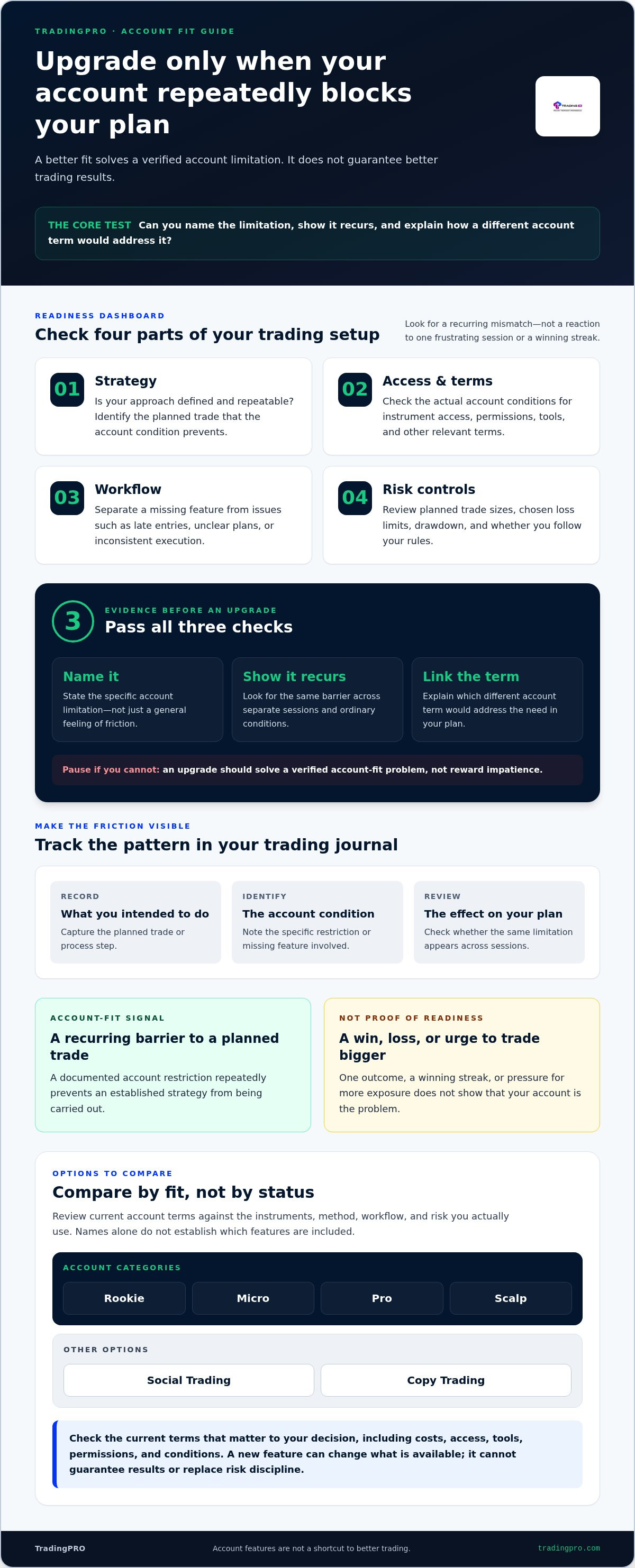
Use this pre-upgrade trading account checklist before you decide
Make the decision a short review, not a reaction to one memorable trade. Work through these checks in order. If you’re unsure at any point, pause and collect more evidence before changing tiers.
- State the reason for upgrading. Write down the exact limitation and how it affects your planned strategy. Be specific: identify what you intended to do, what prevented it, and how often the issue has appeared. Wanting to trade more or move to a higher-sounding tier isn’t a clear account-fit reason.
- Confirm the need persists across sessions. Review your trading journal across multiple sessions. Look for the same account-related obstacle recurring, rather than relying on one frustrating experience, a recent loss, or a winning streak. Note whether the limitation remains relevant in different market conditions and with your usual approach.
- Check feature fit against your actual requirements. List the instruments, tools, and account functions your strategy requires. Compare them with the current account terms and your intended use. For foundational strategy context, TradingPRO’s beginner forex trading guide can help clarify the approach you plan to follow before you assess whether account features match it.
- Review risk controls separately from account access. Check your journal for position sizing, drawdown, and adherence to your pre-set risk rules. Ask whether your decisions remain consistent after both gains and losses. Don’t treat access to another feature as a reason to enlarge positions or loosen limits. An account change should support your process, not replace it.
- Define the value, then review the terms. Decide what a suitable option needs to solve without assuming it will improve returns. Before acting, read the current account information for relevant instruments, tools, fees, eligibility requirements, and conditions. Make sure the terms address your stated need, and understand them before relying on them in your decision.
Pause if urgency is driving the decision. A sudden win can create pressure to scale up, while a loss can make a different tier feel like a reset. Neither outcome proves that your account is the problem. If you’re uncertain, set a date to revisit the decision with updated journal records. That gives you time to see whether the need remains and helps keep emotion out of the decision.
Once your checklist points to a genuine fit issue, review TradingPRO account options against the terms and requirements you’ve recorded.
Explore TradingPRO account options and choose your next step
A clear account decision starts with how you trade, not the status a tier name might suggest. TradingPRO offers Rookie, Micro, Pro, and Scalp accounts as distinct options to compare. Their names alone don’t establish which one fits your approach or which terms apply. Compare the account information with the limitation you identified, the instruments you intend to use, and the risk plan you follow.
Match TradingPRO account options to your trading stage
Use the same feature-fit checklist for every option. That keeps the comparison grounded in your requirements rather than assumptions about what “Rookie,” “Micro,” “Pro,” or “Scalp” must include. For each account, note the documented terms that matter to your trading and base your decision on those details.
- Rookie Account: Evaluate it against your current experience, intended trading approach, and the account terms that apply to your use.
- Micro Account: Compare its documented conditions with the needs you’ve identified, rather than inferring features from its name.
- Pro Account: Consider it if its terms address a specific requirement in your established process.
- Scalp Account: Assess whether its terms align with a strategy you already use, not simply a desire to trade faster or more often.
For each option, review details relevant to you, such as available instruments, tools, costs, eligibility, and conditions. These details determine whether an account suits your intended use, so base your comparison on current account information. Make sure you understand the terms that affect your plan before choosing.
Social Trading and Copy Trading are separate TradingPRO offerings that let clients copy experienced market participants. Consider them separately from account-tier fit: using these features doesn’t, by itself, mean you need a different account tier. Keep each decision tied to its own purpose.
Take a clear next step without rushing
Before selecting an option, write a one-sentence test: “This account fits because its current terms address ___, which I need for ___.” If you can complete that sentence with a real strategy requirement, compare the relevant terms carefully. If your answer rests on status, an assumed benefit, or a hope for improved performance, take time to reassess. A tier change can alter account conditions; it can’t replace a tested strategy or sound risk discipline.
If you’re ready to explore the available options, register for a TradingPRO account, then review the intended account’s current terms before making your selection. Choose based on fit, and keep your trading plan and risk limits in control. That’s the practical answer to when to upgrade your trading account: when a verified account need calls for a better match, not when you expect a new tier to deliver results for you.
Make your next account decision with confidence
Your trading approach will keep evolving. Review account fit when your instruments, routine, or risk capacity changes, not as a badge to earn or a shortcut to stronger performance. If you’re still unsure when to upgrade your trading account, wait until you can name the specific need and explain how the account terms address it. A deliberate decision is progress, even when it means staying with your current setup for now.
When you’re ready to take the next step, compare the available options with your strategy and risk plan in view. Register for a TradingPRO account and make your decision at a pace that keeps your choices clear and controlled.
Frequently Asked Questions
How long should I be profitable before upgrading my trading account?
There’s no fixed period of profitability that makes an upgrade appropriate. Rather than counting profitable weeks, review a broad range of trades that includes different market conditions, gains, and losses. Check whether your strategy and risk decisions stayed consistent throughout. The question of when to upgrade your trading account is better answered by a recurring account limitation than by a calendar milestone or a short run of positive results.
Is upgrading a trading account based only on account balance?
No. Your balance may affect which account conditions apply, but it doesn’t tell you whether a different tier suits your strategy. A larger balance won’t resolve a missing tool or permission, and it doesn’t automatically justify taking larger positions. Compare the account’s current requirements and terms with your intended activity, and consider whether any change still fits your financial circumstances and risk limits.
Can I upgrade my trading account just to access more leverage?
You can consider account terms that affect leverage, but access alone isn’t a sound reason to increase exposure. Leverage can magnify losses as well as gains, so understand how it would affect your position and potential loss under your plan. Check the current terms for the account and instruments you intend to use. If the goal is simply to trade larger, pause and revisit your risk limits before proceeding.
What happens to open trades when I change my trading account?
The treatment of open positions depends on the broker’s account-change process and the terms that apply to the instruments you hold. Don’t assume trades will transfer automatically, remain unaffected, or close in a particular way. Before requesting a change, review the relevant instructions and consider how open positions, pending orders, and account access could be handled. If you can’t establish the effect from the available terms, avoid making the change mid-trade.
Can I downgrade my trading account after upgrading?
That depends on the broker’s current account rules, eligibility conditions, and downgrade process. Before selecting a tier, look for instructions about changing account types again, including requirements that could affect open positions or pending orders. Understand the downgrade process in advance rather than treating it as a guaranteed fallback. If you’re unsure whether an option is reversible, keep your current setup until you’ve reviewed the applicable terms.
Does copy trading mean I should upgrade my account sooner?
No. Using copy trading doesn’t, by itself, mean you need a different account tier. Consider it separately from account fit: understand how copied activity works, what control you retain, and how the associated risks align with your limits. For example, copying a strategy with a different trading frequency or exposure may not match your own tolerance. Choose account features for a clear need, not simply because a platform option is available.
Should I upgrade after a few successful trades?
Usually, a handful of wins is too little evidence to make a tier decision on its own. A short run can reflect favorable market movement, and it won’t show how you respond to losses or changing conditions. Review whether you followed your plan, kept position sizes controlled, and handled losing trades as intended. Upgrade only if a specific account condition is limiting a strategy you’re already applying consistently.


