




- Published on: 2026-10-10 10:08:59
Why Most Traders Lose Money: The Causes and How to Trade More Deliberately

Trading losses rarely come from one bad call alone. More often, risk, strategy, costs, and behaviour work against one another, allowing small mistakes to compound. That’s a more useful way to understand why most traders lose money than blaming every setback on bad luck or a single failed trade.
If you’ve had repeated losses and aren’t sure whether your strategy, position size, trading costs, or emotional decisions are to blame, you’re not alone. The answer isn’t to trade harder or chase a quick recovery. It’s to examine the process behind each decision and make it more deliberate.
This article breaks down common causes of trading losses and shows you how to plan, size, and review trades systematically. You’ll learn how to distinguish a strategy problem from poor execution or market conditions, spot avoidable costs, and set clearer risk limits. We’ll also look at how trading tools, account environments, and options such as Social Trading and Copy Trading fit into a disciplined process, without treating any of them as protection from market risk.
Key Takeaways
- Understand why most traders lose money by looking at how risk, strategy, costs, and behaviour interact, rather than searching for one universal cause.
- Assess position size and leverage carefully: leverage increases exposure, so it can magnify losses as well as gains.
- Review overtrading, revenge trading, and changes to your plan as behaviours to examine, not proof that a particular strategy or indicator will solve the problem.
- Keep a trade record that captures your rationale, planned exit, position size, costs, and emotional state, then adjust one factor at a time.
- Choose trading tools and an account environment to fit your experience and approach. Infrastructure can support execution, but it can’t make a strategy profitable.
Why Do Most Traders Lose Money? Start With the Full Picture
Traders can lose money for different reasons, and those causes often interact. A strategy may have a sound rationale, yet oversized positions can make ordinary price moves costly. Frequent entries add exposure and trading costs, while emotional decisions can pull a trader away from the plan. That’s why the answer to why most traders lose money isn’t one universal mistake. The useful question is which parts of the process are combining to produce repeated losses.
A trading loss pattern is a recurring set of decisions or conditions that turns individual losing trades into cumulative losses. It might involve consistently risking too much, entering without a clear reason, or overlooking costs when reviewing results. This is a pattern to investigate, not an outcome that applies to every trader. Losses are possible in trading, even when decisions are deliberate.
Start by separating the decision from its outcome. Imagine a trader enters according to a defined setup, sets an exit before placing the trade, and follows that plan when the market moves against them. The trade loses, but the result alone doesn’t show that the decision was careless. If the trader instead moves the exit farther away in the hope of a reversal, that change is process evidence worth reviewing.
This distinction matters in day trading, where decisions may unfold over short periods and exposure can change quickly. Day Trading Explained offers background on the practice and its risks, including the use of leverage. Whatever the timeframe, assess decisions against the method you intended to follow, not only by whether a trade ended in profit.
A losing trade is not automatically a failed strategy
One outcome can’t establish whether a strategy has value. A losing streak doesn’t prove a method is useless, just as a brief run of wins doesn’t establish that it works. Review comparable trades for consistent execution, risk, costs, and results over time. If you change your rules after each outcome, you make it harder to tell whether the method or your changing decisions are driving performance.
How small mistakes can compound
Position size determines how much your account is exposed to a price move. If the position is too large, an ordinary adverse move can have an outsized effect on your balance. Add repeated impulsive entries, and you may take trades that weren’t part of your plan, increasing exposure and costs while making results harder to evaluate. Cumulative losses call for a clear process review, not a promised quick fix.
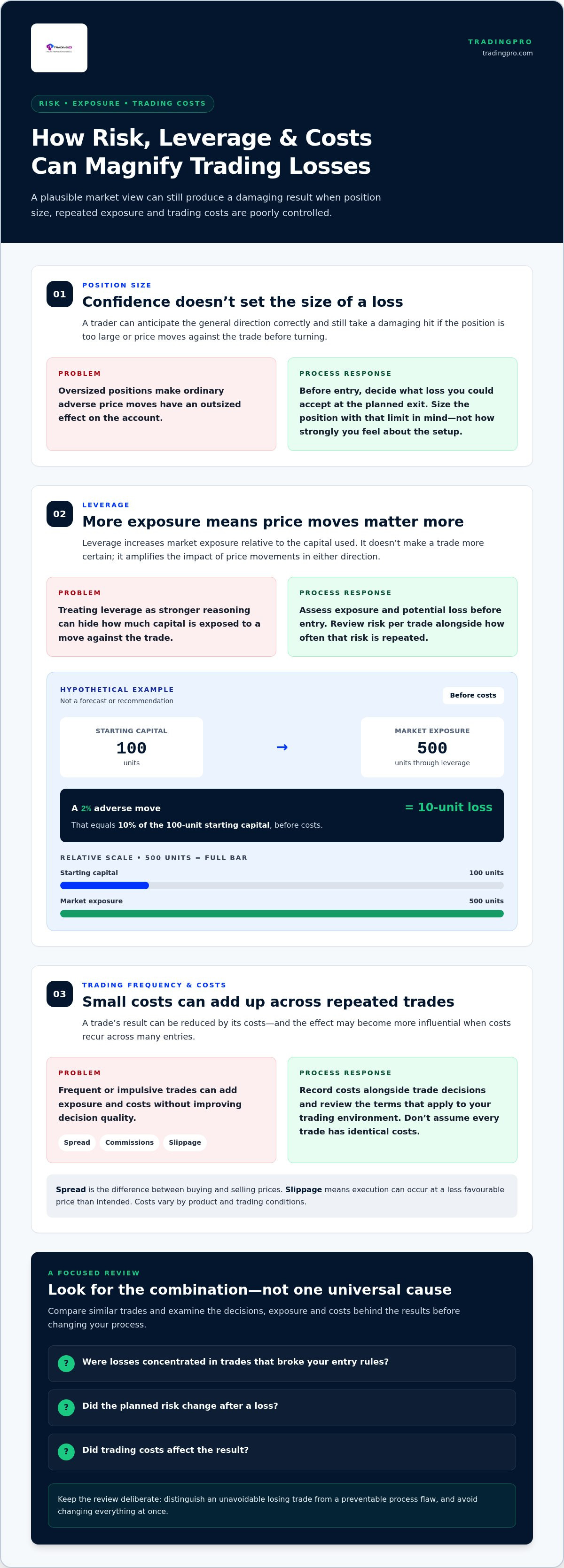
Look for connections before changing everything at once. Were losses concentrated in trades that broke your entry rules? Did the planned risk change after a loss? Did costs affect the result? A focused review helps you identify what to test next and distinguish an unavoidable losing trade from a preventable process flaw.
How Risk, Leverage, and Trading Costs Can Magnify Losses
Trade outcomes depend on more than whether your market view is right. Position size determines how much capital is exposed to a price move, while leverage can expand that exposure beyond the capital committed. Spreads, commissions, and slippage can then reduce the result, especially when trades are frequent. Together, these factors help explain why most traders lose money: a plausible strategy can still struggle if risk and costs are poorly controlled.
Risk per trade sets the potential damage of one decision; repeated exposure determines how often that risk and its costs can affect your account. Assess both before deciding how much to trade.
Why position sizing matters more than confidence
Confidence in a market view doesn’t control the size of a loss. A trader can anticipate the general direction correctly and still take a damaging hit if the position is too large or the market moves against the trade before turning.
Before entry, decide what loss you could accept if the trade reaches its planned exit. Then size the position with that limit in mind, rather than choosing a size based on how strongly you feel about the setup. There’s no single risk limit that suits every trader or situation.
Hypothetical example, not a forecast or recommendation: Suppose a trader has 100 units of capital and takes a position with 500 units of market exposure through leverage. A 2% adverse move would represent a 10-unit loss before costs, equal to 10% of the starting capital. The same market move on a smaller position would have a different impact on capital.
How leverage and repeated trading change the risk
Leverage increases market exposure relative to the capital used. It doesn’t strengthen the reasoning behind a trade or make its outcome more certain. It amplifies the impact of price movements in either direction, so a modest move can have a larger effect on your capital than the underlying move alone might suggest.
Each trade may also carry transaction costs. The spread is the difference between the buying and selling prices; commissions may apply, and slippage can mean an execution occurs at a less favourable price than intended. These costs vary by product and trading conditions. Review the terms that apply to your trading environment instead of assuming every trade has identical costs.
Frequency matters. A cost that seems small on one trade can become more influential when repeated across many entries, particularly if impulsive trades add exposure without improving the quality of your decisions. Keep a record of costs alongside trade outcomes, and consider whether additional trades are creating useful opportunities or simply adding friction.
Build the process first: define acceptable risk, account for possible costs, and decide what conditions justify an entry. Once those steps are clear, you can set up your TradingPRO trading access. TradingPRO provides trading infrastructure, not a guarantee against losses.
The Behaviour and Strategy Mistakes That Keep Traders Losing
Indicators and trading tools can help organise decisions, but none can remove uncertainty or guarantee a winning trade. The same is true of following another trader. Tools and copied positions don’t replace a clear method, suitable risk limits, and the discipline to apply them. To understand why most traders lose money, look beyond the strategy itself: behaviour can weaken a sound approach, while inconsistent execution can make it hard to tell whether the method works.
Separate three possibilities when reviewing results: the strategy may have a flaw; execution may not match the strategy; or the trade may have followed the plan and still lost because markets are uncertain. Each calls for a different response. Changing a method after every loss may obscure the cause instead of fixing it.
- Planned: Enter only when defined conditions are met, then follow the exit rules.
- Reactive: Enter late because a price move looks too good to miss, then change the exit when the trade turns against you.
Use the contrast to examine your trade records: did you follow your criteria, or did the decision change under pressure?
Emotional decisions: chasing, freezing, and revenge trading
Fear of missing out can drive a late entry after much of a move has already happened. Loss aversion can work in the other direction: a trader may close a profitable position quickly to secure a gain, yet keep a losing one open in the hope it returns to break-even. Revenge trading means increasing activity to recover a loss rather than waiting for a valid setup. Treat these as behaviours to investigate, not labels or diagnoses.
Pause after a trade that triggers a strong reaction. Compare your next decision with your written rules. If the entry, exit, or position changed because you felt urgency, fear, or frustration, record that context. One incident doesn’t define your trading, but repeated departures from your plan can reveal a pattern worth addressing.
Why copying a strategy does not remove trading risk
Copying another participant’s positions changes how decisions are followed, not what markets can do. Copied trades remain exposed to price movements and can lose money. You may not share the other trader’s time horizon, risk tolerance, or reasons for entering and exiting. A position that suits one person’s circumstances may not fit yours.
Social Trading and Copy Trading are participation methods, not substitutes for understanding exposure. Before following a strategy, consider what could happen if its positions move against you and whether its approach aligns with your own limits. For a closer comparison of these methods, see the social trading and copy trading guide.
Keep the review specific. Ask whether the method’s conditions were met, whether you followed its rules, and whether the market simply moved against a planned trade. That discipline helps you avoid blaming every loss on emotion or replacing a strategy before you have evidence about what needs to change.
A Practical Process for Finding and Fixing Your Loss Patterns
Repeated losses can feel like one problem, but useful fixes start by finding where the process breaks down. A structured review turns “why most traders lose money” from a broad question into a checkable one: are your entries unclear, are you deviating from your plan, or are costs or market conditions affecting the outcome?
Use this sequence after collecting a meaningful sample of comparable trades. A few results may reflect ordinary uncertainty, so avoid declaring a strategy unsuccessful based on a small run of outcomes. Keep the review consistent and look for repeatable evidence.
- Record. Log the setup, entry rationale, planned exit, position size, costs, execution, and emotional state. Note the result, but don’t let it replace the decision record.
- Classify. Group trades by setup and tag recurring patterns, such as unplanned entries, early exits, rule violations, or unexpected costs.
- Compare with your plan. Check whether each trade met your entry criteria and whether you followed the planned risk and exit. Mark deviations clearly.
- Adjust one factor. Choose one repeatable issue to address, such as entering before a setup is confirmed. Avoid changing several strategy elements at once.
- Review again. Use the same records and criteria after a defined review period. Decide whether the change improved execution or reduced the identified problem, not simply whether the latest trades won.
Build a useful trade journal
A journal should make decisions easier to compare, not become a diary of every market thought. Record the same core details for each trade, then add a short note on what you followed or changed. Separate process quality from outcome: a rule-following trade can lose, and a rule-breaking trade can win. Traders building forex fundamentals can also use this beginner forex trading guide to clarify basic market concepts before reviewing a method.
Keep tags specific and neutral. “Entered before confirmation” is more useful than “bad trade.” Over time, your notes can show whether an issue recurs in a particular setup, market condition, or emotional state. That’s a stronger basis for a controlled adjustment than trying to diagnose a strategy from memory.
Change one variable and review the evidence
Make the adjustment testable. If unplanned entries recur, define the conditions required before entry and track whether you follow them. Set a review point and the criteria you’ll use beforehand. If you’re feeling reactive, pause trading or reduce exposure until you can return to your rules. This won’t promise recovery, but it can help prevent urgency from driving your next decision.
Once your review process is clear, create a TradingPRO account to put your trading approach into practice. Treat the account as infrastructure, while keeping the review and risk rules in your hands.
Choose a Trading Setup That Supports a Disciplined Approach
The right trading setup starts with your process, not a platform feature. First, understand the risk you’re taking. Next, define the method you intend to follow and review how consistently you’ve applied it. Only then assess whether available tools and the account environment support that approach. This sequence keeps the focus on decisions you can control while exploring why most traders lose money, rather than expecting infrastructure to solve a process problem.
Tools can help organise market information and execute decisions, but they can’t make a strategy profitable or remove market risk. Before choosing an account or participation method, ask whether you can explain your approach, identify the risks you’re accepting, and review your decisions clearly. If those foundations aren’t in place, start there.
- Understand risk: Know what could happen if a position moves against you.
- Define your method: Set the conditions for entering, managing, and exiting a trade.
- Review your behaviour: Check whether your actions match those rules.
- Assess tools: Consider whether an account environment supports the way you plan to participate.
Match the account environment to your experience and approach
TradingPRO offers Rookie, Micro, Pro, and Scalp accounts. Compare the available options in light of your experience, intended trading activity, and understanding of risk. Focus on the environment that aligns with your planned approach, rather than assuming an account tier will determine your results. The Rookie Account is one place to begin exploring the available account options.
Keep your decision grounded in what you know about your own process. If you plan a particular style of activity, consider whether your preparation, time commitment, and risk controls fit that plan. Don’t infer features or outcomes from an account name. An account is part of the trading infrastructure; your method and decisions remain central.
Treat social and copy trading as tools, not safeguards
TradingPRO provides Social Trading and Copy Trading through its platform. These are ways to participate, not protection against losses. Automatically replicating another participant’s trades doesn’t remove exposure to market movements or ensure a positive outcome. Consider the approach and risks involved, and decide how any copied positions fit your own limits before participating.
A well-chosen setup can make it easier to put a deliberate process into practice, but it can’t replace that process. Keep your expectations clear, make decisions you can explain, and review your trading activity as you go. If you’re ready to take the next step, create your TradingPRO account and explore the available trading environment at your own pace.
Make Your Next Trade a More Deliberate One
The best next step isn’t to force a winning trade. It’s to make your next decision one you can explain, evaluate, and learn from. That shift puts your attention on the quality of your process, not on trying to control an uncertain outcome.
Understanding why most traders lose money can help you replace guesswork with purposeful action. Set a clear intention before you enter, keep your decisions aligned with it, and give yourself room to review what happened without rushing to recover a loss. Progress comes from applying a sound process consistently, then refining it with evidence.
When you’re ready to put that approach into practice, explore TradingPRO’s trading environment and choose how you want to participate. Create your TradingPRO account and take your next step with focus. Trade deliberately, keep learning, and build your process one decision at a time.
Frequently Asked Questions
Why do most traders lose money?
There isn’t one explanation for why most traders lose money. Losses can follow from a mismatch between a trading method and the conditions it’s used in, or from decisions that drift from the method. To investigate, group trades by setup and market conditions, then compare results after costs. For example, if one setup performs poorly only during volatile sessions, the issue may be context rather than every part of the strategy.
Can beginners avoid losing money when they start trading?
Beginners can reduce avoidable mistakes, but they can’t remove the possibility of loss. Before placing a trade, learn how the instrument moves, how orders work, and what conditions can affect execution. Practise writing down a reason for each entry and an exit condition before acting. If you can’t explain how a trade could lose, pause and learn more before taking exposure.
Does leverage make traders lose money faster?
Leverage can increase how quickly a loss affects your available capital because it increases exposure relative to the capital committed. In a simplified hypothetical, exposure equal to five times capital means a 1% adverse move in the position represents about a 5% change against that capital, before costs. Actual outcomes depend on product terms and market movements, so understand the mechanics before using leverage.
Can copy trading prevent trading losses?
No. Copy trading follows another participant’s positions, but those positions remain exposed to changing markets and can lose value. Execution timing, the trades copied, and the participant’s approach can all affect your result. Before using copy trading, learn what kinds of positions may be replicated and decide how you’ll monitor them. Treat it as a way to participate, not as a substitute for understanding risk.
How can I tell whether my trading strategy is failing?
Look for consistent evidence across comparable trades, not a single losing position. Review whether your planned conditions were met, whether you executed the rules consistently, and whether results change across different market environments. Include transaction costs in the review. If trades followed the method but outcomes remain weak across a sufficiently broad sample, reassess the strategy; if rules were often broken, examine execution first.
Do trading fees and spreads really make a difference?
Yes. Costs can lower net results even when a trade moves in your favour. For example, a small expected gain may be reduced by the spread on entry and exit, any applicable commission, or slippage. The effect can become more noticeable when trading frequently. Review the costs shown for your trades and compare results before and after them, rather than judging performance from price movement alone.
What should I do after a series of trading losses?
Pause before placing another trade, especially if you feel pressure to win the money back. Review recent decisions against your written rules and identify whether the losses share a cause, such as missed entry conditions or a change in market behaviour. If you can’t make decisions calmly, step away until you can. Avoid increasing exposure simply to recover losses; focus first on understanding what happened.
Can a trading platform make a losing strategy profitable?
No platform can turn a weak trading method into a profitable one. Trading infrastructure can help you place orders, view account activity, or organise your process, but outcomes still depend on the strategy, execution, costs, and market movements. Choose tools that support the way you analyse and review trades. Test whether they improve clarity or consistency, and don’t treat convenience as evidence that a strategy works.


